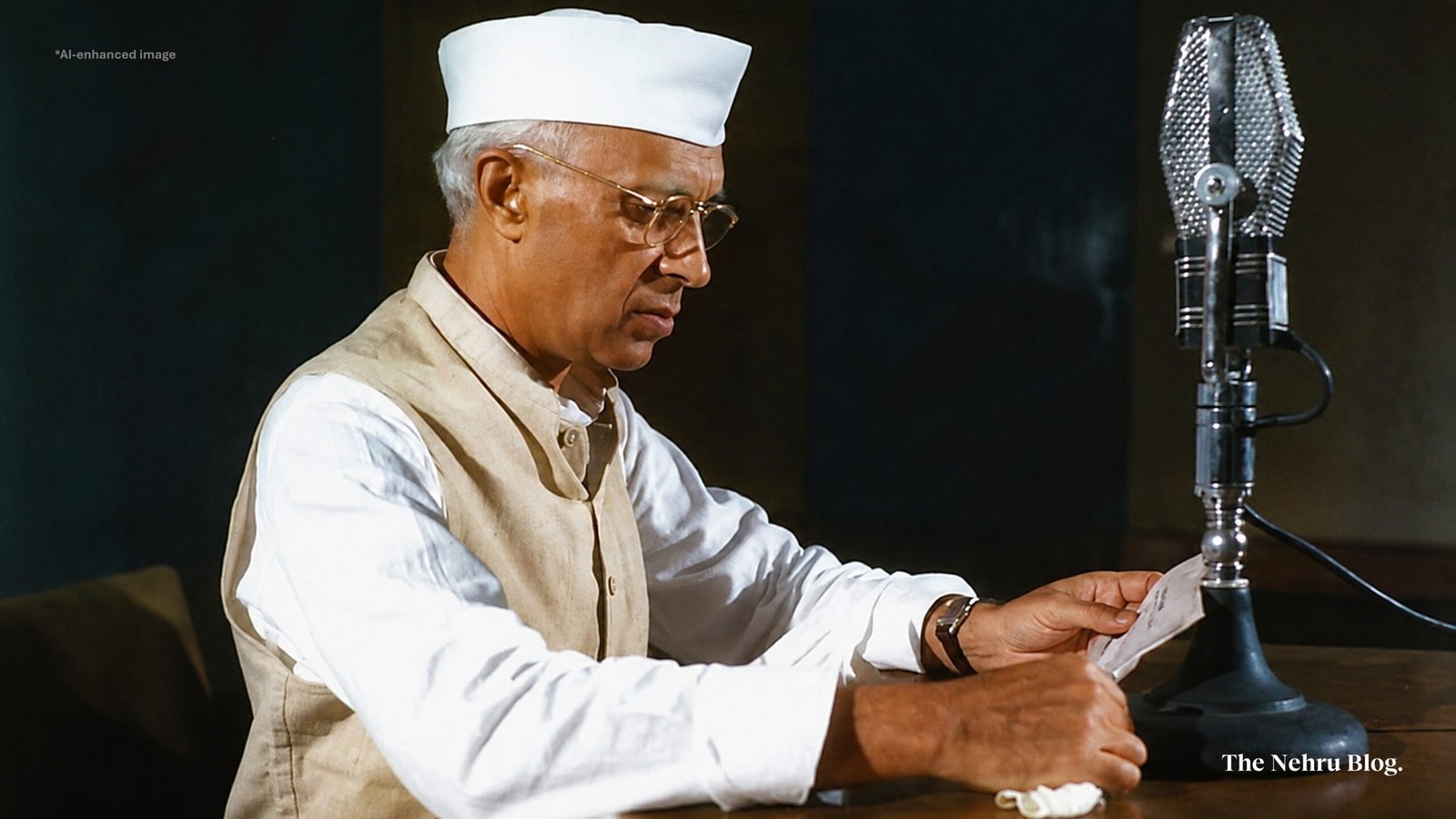
Jawaharlal sent this message on the occasion of the silver jubilee of the Indian Science Congress held at Calcutta on 3-9 January 1938.
Most of us unhappily are too much engrossed in the business of politics to pay much attention to the finer and more important aspects of life. That is natural perhaps in a nation which struggles for national freedom and to rid itself of the bonds that prevent normal growth. Like a person in the grip of a disease it can think only of how to gain health again, and this obsession is a barrier to the growth of culture and science. We are entangled in our innumerable problems; we are oppressed by the appalling poverty of our people. But if we had a true standard of values we would realise that the silver jubilee of the Indian Science Congress this year is an event of outstanding importance. For that Congress represents science, and science is the spirit of the age and the dominating factor of the modern world. Even more than the present, the future belongs to science and to those who make friends with science and seek its help for the advancement of humanity.
On this occasion of the silver jubilee, I should like to send my greetings to the Indian Science Congress and to the many distinguished scientists, our own countrymen and our visitors from abroad, who are assembling in Calcutta. He who was chosen to preside over the Congress session had to end his life’s journey before he could come here, but that life itself of distinguished service in the cause of science and great achievement has a message for all of us. Though Lord Rutherford[2] is not here, his written word has come to us and, through the courtesy of the editor, I have been able to glance through his presidential address.
Though I have long been a slave driven in the chariot of Indian politics, with little leisure for other thoughts, my mind has often wandered to the days when, as a student, I haunted the laboratories of that home of science, Cambridge. And though circumstances made me part company with science, my thoughts turned to it with longing. In later years, through devious processes, I arrived again at science, when I realised that science was not only a pleasant diversion and abstraction, but was of the very texture of life, without which our modern world would vanish away. Politics led me to economics and this led me inevitably to science and the scientific approach to all our problems and to life itself. It was science alone that could solve these problems of hunger and poverty, of insanitation and illiteracy, of superstition and deadening custom and tradition, of vast resources running to waste, of a rich country inhabited by starving people.
I have read therefore with interest and appreciation Lord Rutherford’s remarks on the role of science in national life and the need of training and maintaining research workers.[3] And then I wondered how far all this was possible under our present scheme of things. Something could be done no doubt even now, but how little that is to what might and should be done. Lord Rutherford tells us of the need for national planning. I believe that without such planning little that is worthwhile can be done. But can this be done under present conditions, both political and social? At every step vested interests prevent planning and ordered development and all our energy and enthusiasm is wasted because of this obstruction. Can we plan on a limited scale for limited objectives? We may do so in some measure, but immediately we come up against new problems and our plans go awry. Life is one organic whole and it cannot be separated into watertight compartments. The Mississipi Valley Committee, writing in their Letter of Transmittal to the federal administration of public works, U.S.A., refer to this planning business: “Planning for the use and control of water is planning for most of the basic functions of the life of a nation. We cannot plan for water unless we also reconsider the relevant problems of the land. We cannot plan for water and land unless we plan for the whole people. It is of little use to control rivers unless we also master the conditions which make for the security and freedom of human life”.
And so we are driven to think of these basic conditions of human life, of the social system, the economic structure. If science is the dominating factor in modern life, then the social system and economic structure must fit in with science or it is doomed. Only then can we plan effectively and extensively. Lord Rutherford tells us of the need for cooperation between the scientist and the industrialist. That need is obvious. So also is the need for cooperation between the scientist and the politician.
I am entirely in favour of a state organisation of research. I would also like the state to send out promising Indian students in large numbers to foreign countries for scientific and technical training. For we have to build India on a scientific foundation, to develop her industries, to change the feudal character of her land system and bring her agriculture in line with modern methods, to develop the social services which she lacks so utterly today, and to do so many other things that shout out to be done. For all this we require trained personnel.
I should like our central and provincial governments to have expert boards to investigate our problems and suggest solutions. A politician dislikes and sometimes suspects the scientist and expert. But without that expert’s aid the politician can achieve little.
And so I hope, with Lord Rutherford, “that in the days to come India will again become the home of science, not only as a form of intellectual activity but also as a means of furthering the progress of her people”