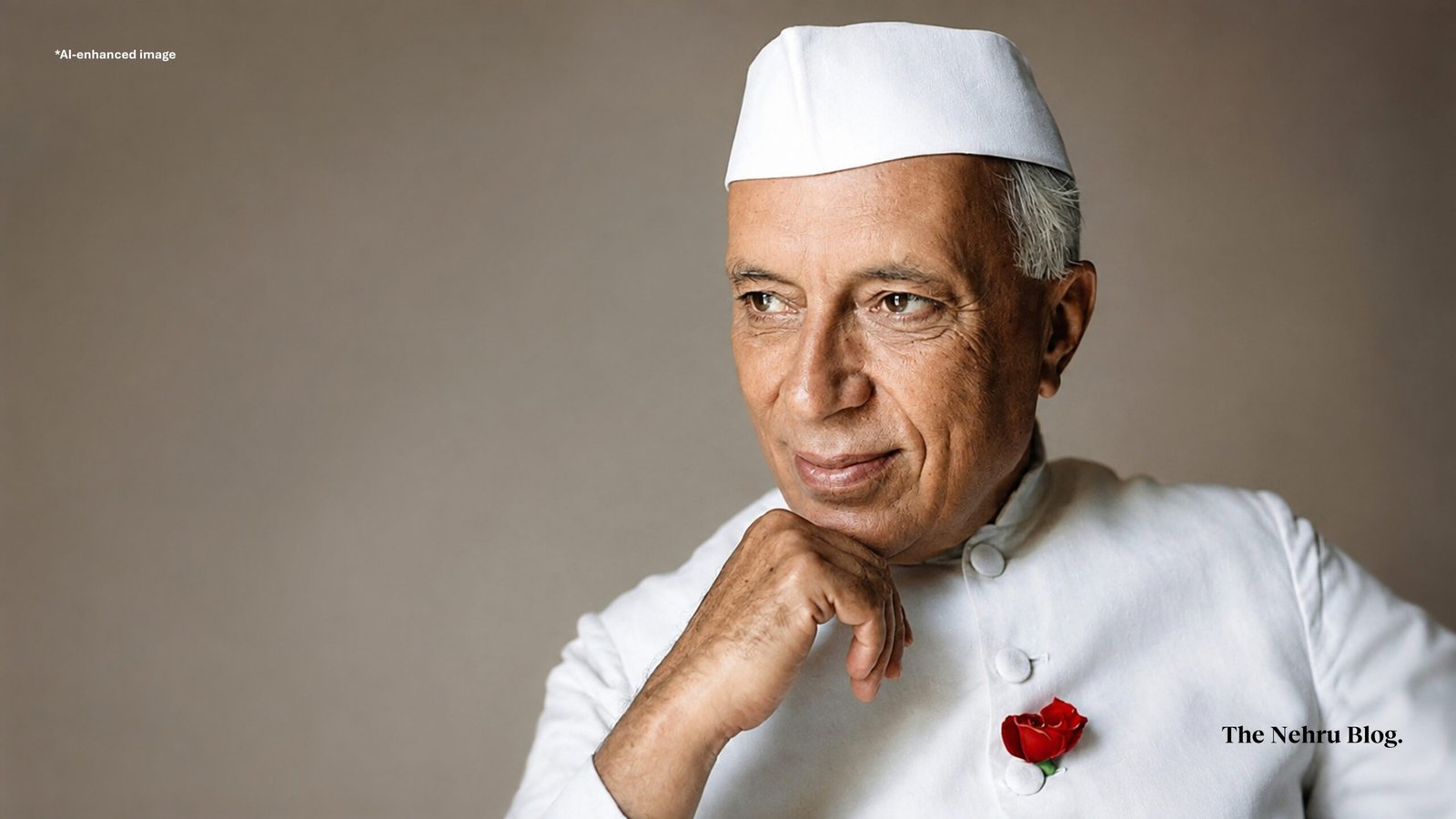
Excerpts from Jawaharlal Nehru’s speech at Gandhigram (near Madurai) December 8, 1957
I have been here about eight or nine hours now since this morning, and I have breathed the air of this place and sensed the atmosphere here, seen many faces, young and old, and also looked at these hills and mountains capped by clouds.
I have felt more and more at home, more and more fascinated by this place, more and more impressed by the work that is being done here quietly.
Perhaps you know, or you may not know, that I am a child more of the mountains than of the plains, of the mountains in the North, the Himalayas. So when I first arrived here, I was charmed at seeing these hills round about and I felt how well this site of Gandhigram had been chosen.
Sitting here, looking at all of you and looking at these mountains which surround us, I think of the mountains in the North, the ice-covered Himalayas, and I think of all this great country of ours, Bharat, in between, and the hundreds and millions of people living here, many of them appearing to be different from one another, with different languages, maybe different clothing, but all tied together in a hundred ways and today all of them working jointly for this great adventure of building a new India.
Do you remember those years when all of us struggled for the freedom of India, when throughout this great land, the North and the South, we worked all together under our great leader, the Father of the nation, Mahatma Gandhi?
We worked then for the whole of India, whether in the South or the North, or the East or the West — we wanted the freedom of India, not of one part of India of the North or the South but the whole of India — because we realized that the fate of all of us in any part of India is tied up, and we either gain freedom, all of us, or no one does it.
So we worked together, we sacrificed together and we gained the freedom of India together. And now we have to face a bigger and a greater task and that is to build up a new India where we will put an end to poverty, misery and unemployment. So, we have now to build this great India and we have to work for this also together, not separately, because if we work separately we are weak but if we work together India is strong.
So, the first thing we must remember always and never forget is the lesson of the unity of India that all of us, whatever State or province we may come from, whatever language we may talk in, whatever religion we may follow, are all sons and daughters of India, working together as if they were in a large family for the good of all of us.
It is important because many people forget this and quarrel either in the name of religion or province or language or caste or something else. Remember that this part of the world, where you live in, is, of course, yours. But this is not the only inheritance that you have got. Your inheritance is the whole of India, from the Himalayas to Kanniyakumari; it belongs to each one of you. And in the same way the whole of India belongs to me and others also. We are joint partners, joint inheritors in this, in this great land.

I want you to remember this, because in India there are many big States — there is Madras, there is Andhra, there is Uttar Pradesh, Bengal, Bombay, Punjab, Mysore. But they are all parts of this great country of ours. There are many religions. There is the Hindu religion, there is Islam, there is Christianity, there is Buddhism and there are others. There are different languages and great languages.
There are many castes, hundreds and thousands of them, I do not know how many. Now, some people think that all these are barriers separating us and yet if we allow them to separate us then we become weak and we cannot help each other or make any progress in India.
You live in Madras State. But you are citizens not of Madras State. You are citizens of the Republic of India, and if you go abroad you take a passport, telling the world that you are a citizen of the Republic of India and you are honoured because you are a citizen of India, not because you come from this State or that State. Therefore, what gives us credit in the world, what brings us honour in the world, is that we are citizens of India, and not of a particular town or district or State.
Different provinces do not separate us, just as different districts do not separate you. Different languages do not separate us. All the great languages of India are old, well-established, advanced languages and they are sister languages. We have to help all of them.
Some people think that people in the North want to impose Hindi on other people, and some people get very excited about it and write and shout about it. Well, I want to tell you that there is no question of any imposition of any language. There can be none. We have to decide these matters without imposition, without compulsion or coercion. We have to decide them cooperatively, in a friendly way, to our mutual advantage.
We have many religions in this country and they have lived generally at peace with each other for thousands of years. It has been the tradition of India for people of one religion to tolerate the people of another religion. That has been the hallmark of Indian culture.
And yet some people have made religion a battlecry for fighting each other. Some people have degraded religion. Some people have built up communal organizations, bringing religion into politics. Much harm has been caused to our country because of this. Therefore, let us remember that we have to honour not only our own religion but also the religions of others.
A very great ruler of India who lived 2,300 years ago, the Emperor Asoka, said that he who honours another man’s faith honours his own and the others will honour his faith. But if he does not honour the other man’s faith, his own faith also will not be honoured.
So, we have had this lesson of tolerance for ages past in India. That is the true spirit of India and we must always remember that and respect each other’s religions, each other’s faiths, and not try to coerce our own views on others.
And now I come to caste. I am not friendly to caste. Caste in India during the last many hundreds of years has been a curse. It has weakened India, it has degraded India, it has made us slaves in India to foreign conquerors; because caste split us up, it took away the feeling of unity from us, because caste degraded large numbers of our own countrymen, because many of us accepted this degradation.
But I shall not go into the past. Whatever virtues or failings may have been in the past, in the world of today caste or the caste system has no place and, if it exists, it can only weaken us and prevent us from realizing our objective.
What is our objective? What do we aim at in India? After we gained Independence, one journey was ended. But another journey began, a longer journey, the journey of the Indian people towards social progress, towards economic progress, towards welfare, towards ending of poverty, towards living of a fuller life.
Our National Congress, our great national organization, has laid down in its constitution that our objective is to attain a classless and a casteless society, to build up a socialist pattern of society, in other words, a society in which all people have an equal chance, in which there is a great measure of equality.
Now, how can you attain this, if you divide up your society into strata of caste? You cannot do it, because the caste system is opposed not only to socialism, but to democracy, to all ideas of equality, all ideas in the present world of working together, cooperating together.
I know that this caste system and caste ideas lie deep down in our society and in many of us and it is not an easy matter to uproot them completely. But we shall have to try and we shall have to uproot them even though it might take some time, because unless this is done, we cannot obtain our objective, which I have just defined to you.
Recently, near this place, in the district of Ramanathapuram, as you know, there have been very serious riots.1 Many people had been killed, much property destroyed and large numbers have suffered. Now I am not here expressing any views as to who was guilty and who was not. But it was a terrible thing for us to hear, and for you to see perhaps, these riots between people of different castes.
It showed up how these caste differences persist, caste animosities, how one caste tries to dominate over another and objects to the advance of some other caste. It shows what a great danger we have to face. I am very sorry for these troubles. But perhaps these troubles have done one good that it has made everybody think of the dangers of the persistence of this caste spirit.
Therefore, we must become wary of it and we must try to root it out not by fighting each other but in more peaceful ways, by convincing each other, by cooperating with each other.
- About 40 persons were killed in clashes between Maravars and Harijans which lasted for eleven days from 14 September 1957. See also Selected Works (Second Series), Vol. 39, pp. 381-382. ↩︎